

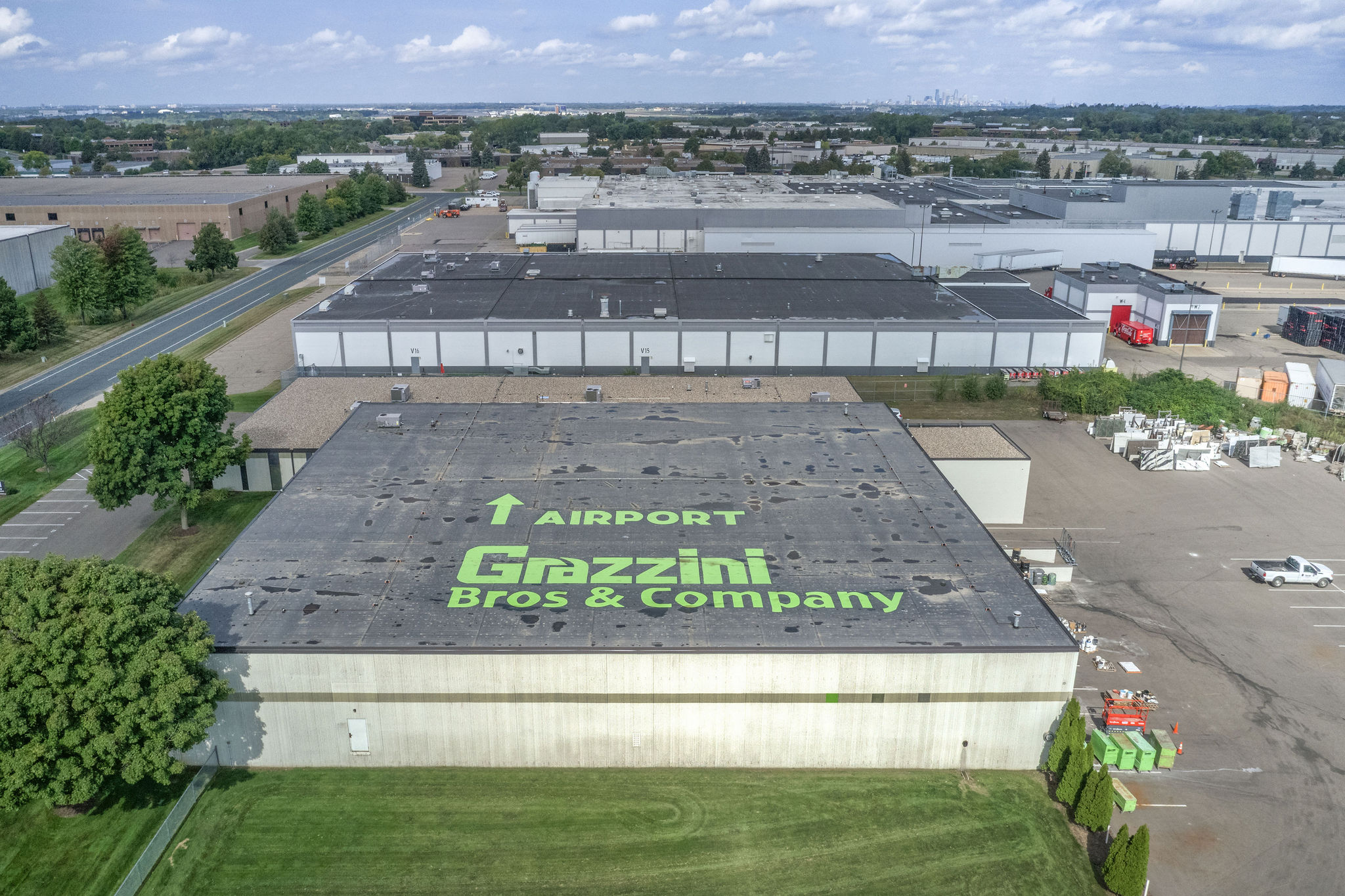
How Mint Roofing Turned Grazzini’s Aging Roof into a Branded, Reliable Asset Under MSP’s Flight Path
We recently sat down with our own Kevin Krolczyk, President/Visionary/Partner; Christy Lewis, Executive Vice President/Integrator/Partner; and Jeff Lahr, Commercial Sales, to discuss a project for Grazzini Brothers & Company, an Eagan, Minnesota-based nationwide commercial flooring contractor.
The project involved transforming an aging, leak‑prone roof into a long‑term asset with tapered insulation, improved drainage, and bold rooftop graphics pointing toward the Minneapolis–St. Paul International Airport’s runway, while tightening internal processes after an unexpected weather event.
A Specialty Flooring Leader with a Rooftop Landmark
Grazzini Brothers & Company has been installing commercial flooring and surfaces since 1923, earning a reputation as a leading specialist for large, complex projects. Their corporate headquarters sits on Eagan Industrial Road in Eagan, Minnesota, just 2.5 miles from MSP International Airport’s runways, directly under a busy flight pattern.
From the air, Grazzini’s building is more than a dot on the map. The roof carries the company name plus a large arrow and the word “Airport,” pointing directly toward the MSP runway.
It is a playful, memorable landmark for pilots and passengers flying to and from the Twin Cities. Yet beneath that distinctive branding, the existing roof system was quietly reaching the end of its useful life, creating growing challenges for the people and projects inside.
The Roofing Challenge Above a Nationwide Operation
Grazzini operates across the country, but its Eagan headquarters is the hub for project management, estimating, and operations. The building is a single structure with multiple roof sections: an office wing, a warehouse, a canopy, and an attached garage. Over time, the original roof system began to fail in ways facility managers everywhere will recognize:
- Flat insulation allowed water to sit on the roof instead of draining away.
- Chronic ponding led to leaks, especially around walls and ceiling tile areas.
- The rubber membrane shrank, pulling at the walls and requiring wood blocking to keep them aligned.
Operationally, these problems meant recurring cleanup, stained ceilings, and increased risk to interior finishes, equipment, and office spaces where projects are managed.
Strategically, Grazzini was approaching its 100th anniversary and wanted its headquarters to reflect the same reliability and craftsmanship it delivers on flooring projects across the country.
From Preventative Maintenance Partner to Re‑roof Strategist
Mint Roofing had been providing preventative maintenance and roof inspections for Grazzini, documenting roof conditions and flagging concerns over several years. That long‑term professional relationship set the stage for a bigger conversation. Instead of patching leaks, it was time to plan a multi‑section re‑roof to address root causes and support Grazzini’s ongoing growth.
The Mint team started with a thorough walk‑through of the roof, examining each section. They looked at membrane shrinkage, ponding patterns, existing drain locations, and interior damage. At the same time, they listened closely to Grazzini’s goals: dependable performance, minimal disruption to office and warehouse operations, and protection of the rooftop graphics, the company name, arrow, and “Airport” text that make their headquarters a recognizable landmark for planes traveling to and from MSP.
Mint’s approach blended education and strategy. The team explained the trade‑offs among commercial roofing systems, the importance of proper drainage for roof asset management, and how proactive planning could support predictable maintenance budgets rather than surprise emergency spending.
Designing EPDM Systems That Match Performance and Branding
The solution centered on EPDM (ethylene-propylene-diene monomer), a commercial roofing material commonly used in Minnesota known for its durability and flexibility. Mint Roofing recommended EPDM across the building, but in two system types tailored to each section and Grazzini’s branding needs:
Ballasted EPDM over the office area
- The membrane is held in place with rock ballast.
- This approach is more economical up front and matched the existing configuration, making it a practical choice for the office wing where staff oversee complex flooring and surfaces projects.
Fully adhered EPDM over the warehouse
- The membrane is glued directly to the substrate.
- This creates a smooth surface that makes it easier to see and repair punctures and provides an ideal canvas for the rooftop logo, arrow, and “Airport” lettering.
To address the root cause of Grazzini’s leak issues, Mint designed a tapered insulation system that introduced slope where none had existed and added new roof drains and rain leaders to move water off the roof efficiently.
The goal was clear: eliminate ponding, reduce the risk of leaks, and turn the roof into a predictable, manageable asset rather than a recurring source of headaches.
From a branding standpoint, the fully adhered EPDM over the warehouse allowed Grazzini to enhance its rooftop identity. Instead of fighting wind‑blown rock that scattered or obscured graphics, the new system gave the company a clean, stable surface for its logo, arrow, and “Airport” message, creating a sharper, more durable visual for every plane flying over Eagan toward MSP International Airport.
Turnkey Coordination for a Busy Headquarters
Because the project touched both roof performance and interior systems, Grazzini asked Mint Roofing to act as a turnkey partner and coordinate multiple trades. Rather than hiring separate contractors and hoping they aligned, Grazzini wanted a single point of accountability for the entire scope so their team could stay focused on their core business.
Mint’s responsibilities included:
- Raising mechanical curb units to match the new roof height.
- Installing new roof drains and tying them into the building’s plumbing.
- Setting new rain leaders and routing them through office and café spaces.
- Coordinating electrical and mechanical adjustments related to the roofing work.
Daily communication helped coordinate interior access, storage moves, and office disruptions so staff knew when work would occur and what spaces would be affected. The result was a cohesive project experience that respected the rhythm of a busy headquarters.
When MSP’s Weather Changes the Story
Despite careful planning, the project encountered a serious test in the form of weather. On a late day during the re‑roof, portions of the roof were not fully sealed. The crew checked the radar, saw what appeared to be favorable conditions, and decided to complete sealing the next morning. Overnight, the forecast shifted. Heavy rain moved across MSP’s flight path and hit the open sections before crews could return.
The result was significant interior damage, far beyond the small ceiling tile leaks Grazzini had managed in the past. Office and warehouse spaces were affected, and the project suddenly became a real‑world test of how a commercial roofing partner responds when something goes wrong at the headquarters of a long‑standing client.
Mint Roofing did not distance itself from the incident. Instead, the team:
- Mobilized quickly to manage cleanup and protect interior spaces.
- Coordinated with Grazzini’s staff to address damaged areas.
- Compensated the company for staff time spent on cleanup activities.
For a client with decades-long ties to Mint’s leadership, the situation was sensitive. But the response reinforced Mint’s commitment to “do the right thing” for every client and every project, regardless of personal connections. Accountability, restoration, and learning took priority over excuses.
Turning a Difficult Moment into Stronger Processes
Internally, the weather event became a catalyst for stronger procedures. Mint Roofing tightened its policies regarding open-roof conditions and weather risk, updating its standards in direct response to what happened on the Grazzini project.
A central principle emerged: crews must treat every night as if a major storm could arrive, and the decision to leave a section open cannot rest solely with field staff.
This shift reflects Mint’s broader philosophy:
- Plan for worst‑case weather when evaluating overnight exposure.
- Build processes that prioritize protecting the client’s building and operations over short‑term scheduling convenience.
- Use challenging experiences to improve systems, training, and communication, not to shift blame.
For Grazzini, the incident meant downtime, disruption, and the need for extensive cleanup. But it also gave them a clear view of their contractor’s character. They saw a partner willing to take responsibility, compensate for impacts, and change operations to reduce future risk for their Eagan headquarters and for other commercial clients across the region.
Results: A Reliable Roof and a Stronger Brand Touchpoint
By the time the project was complete, Grazzini’s building had a roof that matched the demands of its business and its unique location under MSP’s flight path:
- Improved drainage through tapered insulation and new drains, eliminating chronic ponding and associated leaks.
- Reduced leak risk and easier inspections with a fully adhered EPDM system over the warehouse that makes punctures and other issues more visible.
- A refreshed rooftop identity featuring the Grazzini logo, a large arrow, and the word “Airport,” all clearly visible to aircraft arriving at and departing from MSP International Airport.
- A streamlined project experience with a single commercial roofing partner coordinating roofing, mechanical, electrical, and plumbing work.
Most importantly, the professional relationship remained strong. Grazzini saw the difference between a vendor that simply “gets you dry” and a partner committed to keeping you dry and standing behind their work when the unexpected happens at a critical facility.
Practical Lessons for Facility Managers and Building Owners
For facility managers, operations leaders, and building owners, particularly those responsible for headquarters or high‑visibility facilities, the Grazzini case offers several practical insights:
- Treat the roof as a strategic asset. Regular inspections and preventive maintenance help identify end‑of‑life conditions early, enabling planned re‑roof projects rather than crisis responses.
- Prioritize drainage design. Chronic ponding is a clear sign that slope and drains need attention. Tapered insulation and properly placed drains can dramatically reduce the long‑term risk of leaks.
- Match systems to use and branding. Ballasted EPDM may offer lower initial cost, while fully adhered EPDM can simplify maintenance and provide a better surface for rooftop graphics.
- Use turnkey coordination to reduce friction. A single commercial roofing contractor managing related trades keeps projects cohesive and minimizes operational disruption.
- Value accountability as much as technical expertise. No project is immune to unexpected events, but a partner who owns issues, communicates clearly, and improves processes is invaluable.
Conclusion: A Roof, an Arrow, and a Long‑term Partner in Eagan
Grazzini’s story is about more than replacing an old roof. It is about a long‑term professional partnership between a commercial flooring and surfaces specialist and a commercial roofing specialist, a headquarters located just miles from MSP International Airport, and a contractor willing to stand in the gap when weather disrupts a well‑planned schedule.
Today, the rooftop logo, arrow, and “Airport” lettering sit on a system designed for performance and visibility. This roof supports both the brand and the people managing complex flooring projects across the country. For organizations throughout Minnesota and the Upper Midwest, the case illustrates what it means to have a commercial roofing contractor that thinks beyond the next storm and sees your roof as part of the story you tell.
FAQs
What are the most common commercial roofing systems and how do they differ?
Common commercial roofing systems include EPDM, TPO, PVC, metal, and built‑up roofs. EPDM is a flexible rubber membrane often used on low‑slope roofs. TPO and PVC are single‑ply membranes that offer heat‑welded seams and strong resistance to chemicals and UV. Metal roofs provide long life and strong structural performance but may require more detailed flashing work. Built‑up roofs use multiple layers of bitumen and felt or fabric for durability. The best choice depends on climate, building use, budget, and maintenance preferences.
Why does drainage and ponding water matter so much on commercial roofs?
Drainage is critical because standing water adds weight, accelerates membrane wear, and increases the risk of leaks at seams, penetrations, and edges. Chronic ponding can also hide damage and make inspections less effective. Good commercial roof design uses tapered insulation, correctly placed drains and scuppers, and proper slopes to move water off the roof quickly, reducing long‑term leak risk and structural stress.
What is EPDM roofing and when is it a good option for commercial buildings?
EPDM (ethylene propylene diene monomer) is a synthetic rubber membrane commonly used on low‑slope commercial roofs. It is known for flexibility, UV resistance, and performance in extreme temperatures. EPDM can be installed as ballasted, mechanically fastened, or fully adhered systems. It is often a good option when building owners want a proven, durable system that can be repaired relatively easily and performs well in climates with wide temperature swings.
What is the difference between ballasted and fully adhered commercial roof systems?
In a ballasted system, the membrane is held in place by stone or pavers laid over the surface. This can reduce upfront costs and add weight that resists wind uplift, but it can make locating punctures and leaks more difficult. In a fully adhered system, the membrane is glued directly to the substrate, creating a smooth surface. Fully adhered roofs often simplify inspections and repairs and can be better suited for roofs that will carry graphics, solar arrays, or need easier visual monitoring.
How can building owners reduce the risk of leaks during a commercial re‑roof project?
Leak risk during a re‑roof can be reduced by careful planning and daily protection measures. Key practices include phasing work so only limited areas are open at one time, fully sealing exposed edges before crews leave for the day, monitoring weather forecasts closely, and having contingency plans for sudden storms. Clear communication between the roofing crew and building staff also helps ensure sensitive interior areas are protected and that any issues are addressed quickly.