

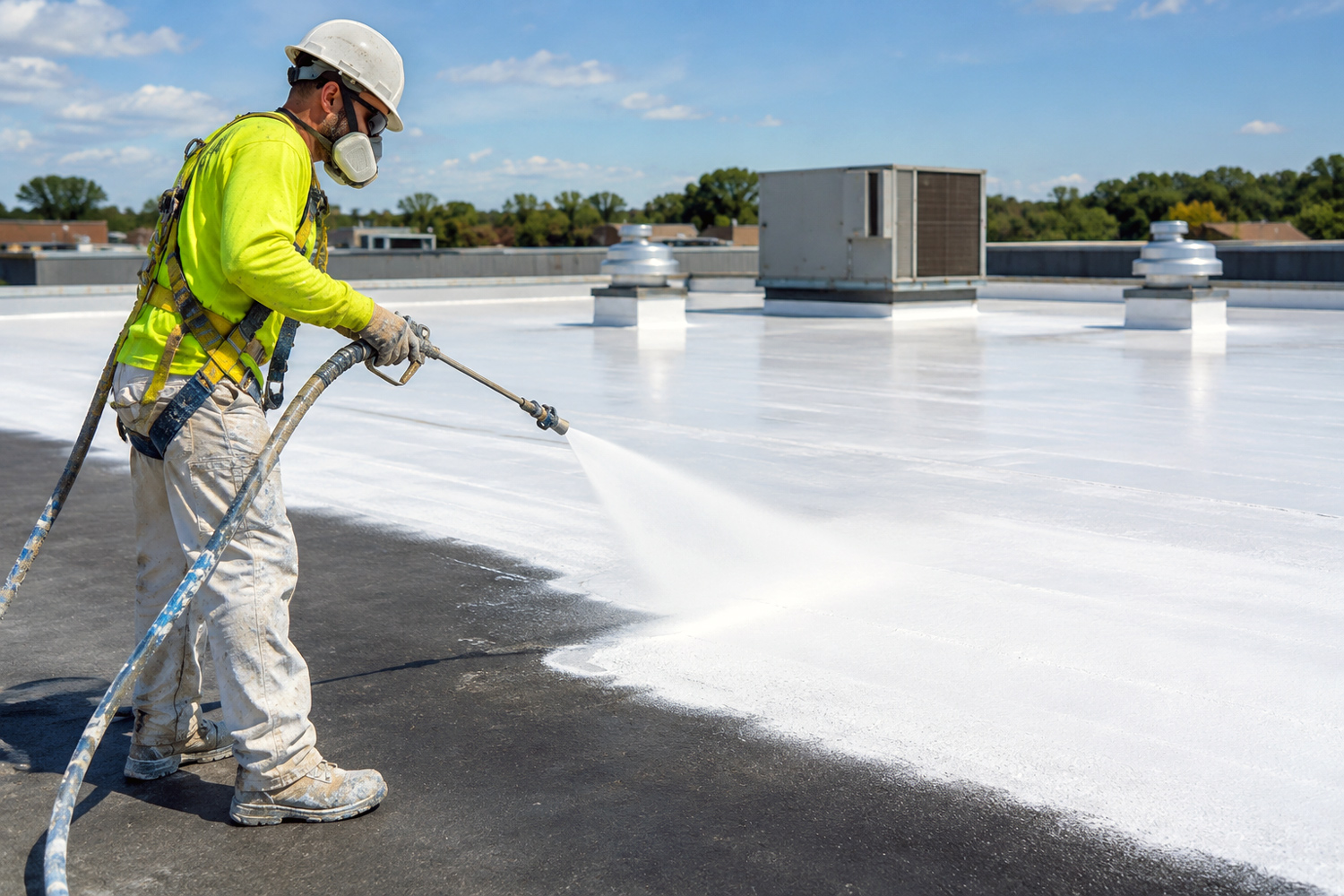
You’ve probably seen companies promoting sprayed-on roof coatings as an alternative to conventional flat-roof repairs recently. The promise of extending your commercial roof’s life without the cost of replacement is appealing. But does your roof actually need a coating, or would routine maintenance and targeted repairs be the smarter investment?
Before paying to coat your entire roof, take a closer look at what these products can do, what they can’t, and whether they’re the right choice for your building.
At Mint Roofing, we don’t offer sprayed-on roof coatings. Our approach centers on evaluating your roof’s condition, addressing problems, and helping you make informed decisions about maintenance, repairs, and replacement.
Here’s why we believe a coating proposal deserves scrutiny.
A Coating Doesn’t Fix What’s Wrong Underneath
The biggest question about a roof coating isn’t what the finished surface will look like. It’s what you’ll be covering up.
A coating is applied over an existing roofing surface. Its suitability depends on the roof’s condition and the work done before application. Industry guidance calls for evaluating the substrate, making repairs, and preparing the surface before applying a coating.
Wet insulation, deteriorated materials, and other underlying problems cannot simply be coated away. Wet materials must be identified and removed, and defects such as damaged flashing or open seams need appropriate repairs.
That puts an important limit on the sales pitch: a coating is not a shortcut around diagnosing and repairing your roof.
If your roof is leaking, the first priority should be finding out why, not pricing a treatment for the entire surface.
The Roof Has to Qualify Before the Coating Makes Sense
There’s a catch worth understanding.
A roof needs to be suitable for restoration before a coating makes sense. A weathered roof with a sound underlying assembly may qualify. A roof with saturated insulation or significant deterioration presents a different problem.
That does not mean every roof must be in perfect condition before it can be coated. Localized repairs may make a roof eligible. But the more serious the underlying problems, the less useful it is to talk about a coating before addressing them.
For a building owner dealing with recurring leaks or years of deferred maintenance, this distinction matters. The problems that make a coating sound appealing may also be the ones you must fix before you can even consider the coating.
“Restore instead of replace” is an attractive message. It is not, by itself, a diagnosis.
If the Repairs Solve the Problem, Why Coat the Entire Roof?
Before approving a coating proposal, ask the contractor to separate the necessary repairs from the coating application.
What will fixing the flashing accomplish? What will repairing the seams accomplish? What will replacing damaged material accomplish?
Then ask the question that matters most:
What additional problem does coating the entire roof solve?
On a suitable aging roof, a restoration system may add a protective, waterproofing surface and help postpone replacement. That is a legitimate potential benefit, but it is not the same as proving that your roof needs it.
If targeted repairs and continued maintenance can meet your needs, a full-roof coating deserves a clear justification.
The comparison should not stop at “coating costs less than replacement.” Ask whether replacement is necessary in the first place. Otherwise, you may be comparing a proposed expense with a much larger expense you don’t currently need.
The Coating Price Isn’t the Full Cost
A coating proposal may look affordable compared with roof replacement. But the installation price is only part of the financial picture.
Coated roofs still require regular inspections, maintenance, and repairs. GAF’s roof-coating care guidance also notes that damaged or worn areas may need additional coating. Those are ongoing responsibilities, not expenses that disappear once the application is complete.
Before signing, ask which costs are included in the proposal and which will come later:
- Inspection and maintenance visits: What schedule is required, who performs the work, and what will those visits cost?
- Cleaning and debris removal: What upkeep does the coating manufacturer specify, and is that service included?
- Repairs to damaged or worn coating: How will those areas be repaired, and what falls outside the warranty?
- Future recoating: Does the proposed system anticipate another application, and what preparation and expense would that involve?
- Warranty compliance: What must you document, which services must you pay for, and what happens if you miss a requirement?
The answers will depend on the specific system and contract. Get them in writing rather than assuming that a long warranty means years without additional expenses.
These costs may not be hidden in the contract, but they can be easy to overlook when the sales pitch focuses on upfront savings.
For a fair comparison, ask for the cost of the coating, the repairs required before installation, and the upkeep expected afterward. Then compare that with maintaining and repairing your existing roof without a coating.
You are not choosing between a coating and ongoing maintenance. You are considering an additional investment that comes with ongoing maintenance of its own.
Read the Warranty, Not Just the Number of Years
A long warranty can make a roof coating sound like a low-risk investment. But the number of years on the proposal does not tell you what happens if the roof leaks or who pays to fix it.
Before treating the warranty as a selling point, request the actual document and ask the contractor to walk you through it. Don’t assume the coverage matches the promises in the sales presentation.
Get clear answers to these questions:
- What is covered? Does the warranty cover only the coating material, or does it also cover application labor and leak repairs?
- What is excluded? How does it address problems involving the existing roof, trapped moisture, ponding water, flashing, and penetrations?
- Who is responsible? Is the warranty issued by the manufacturer, the installer, or both? Who do you contact when there’s a problem?
- What must you do to keep it in effect? Are inspections, cleaning, maintenance, or written service records required? Must an approved contractor perform the work?
- What happens if a claim is approved? Will the provider supply replacement material, pay for repairs, or cover labor too? Does the available coverage decrease over time?
- What are the reporting deadlines? How quickly must you report a leak, and what documentation must accompany the claim?
The answers depend on the specific warranty. Get them in writing before signing, not after a leak develops.
Remember, coated roofs still require maintenance and repair. A warranty does not remove those responsibilities or make the roof maintenance-free.
If the sales pitch emphasizes “20 years of protection,” ask the contractor to show you exactly what that protection includes. You’re making a decision about your building, not buying a number on a brochure.
Start With a Roof Assessment, Not a Product Recommendation
Before considering a major project, ask for an assessment that explains:
- What is wrong with the roof now.
- Which repairs are necessary.
- Whether moisture is present within the roofing assembly.
- Whether continued maintenance and targeted repairs are reasonable.
- Why restoration or replacement is being recommended.
Roof evaluation, moisture investigation where appropriate, and preparation requirements help establish whether a roof is suitable for coating. Those findings should drive the recommendation, not follow it.
Be cautious about a proposal that spends more time describing the product than explaining your roof.
A recommendation should connect documented conditions to specific work. You should understand what needs attention now, what can be monitored, and why a larger investment is or isn’t appropriate.
Knowing Your Roof’s History Puts You in a Stronger Position
A major roofing recommendation is easier to evaluate when you have a record of your roof’s condition and previous repairs.
Mint Roofing’s TopSite Preventative Maintenance program uses inspections, photo documentation, and service records to help building owners track roof conditions and plan for needed work.
That history puts recommendations in perspective. You can see which areas have needed attention, what work has been completed, and whether conditions are changing.
Whether you choose a scheduled maintenance program or arrange inspections and repairs as needed, the goal is to make decisions based on the roof you have, not just the product being promoted.
Before You Coat Your Roof, Know What You’re Paying For
A sprayed-on coating is not a substitute for finding leaks, repairing damage, or maintaining your commercial roof. And a lower price than replacement means little if your roof doesn’t need replacement in the first place.
Before committing to a full-roof treatment, insist on a clear explanation of what it will accomplish beyond the necessary repairs. Add up the ongoing maintenance costs. Read the warranty. Most importantly, ask whether you’re paying to solve a problem or adding an expense you could avoid.
At Mint Roofing, we don’t offer sprayed-on roof coatings. We focus on helping you understand your roof’s condition and make practical decisions about maintenance, repairs, and replacement.
Your roof may need attention. That doesn’t mean it needs a coating.
Contact Mint Roofing for a commercial roof inspection and a straightforward conversation about your options.
Frequently Asked Questions About Commercial Roof Coatings
Are sprayed-on commercial roof coatings worth it?
A sprayed-on coating may be worthwhile for an aging commercial roof that is suitable for restoration, but it is not automatically the best investment. Necessary repairs must come first, and the coating should provide a clear benefit beyond those repairs. Before committing, compare the complete coating project with the cost and practicality of maintaining and repairing your existing roof.
Can a roof coating replace commercial flat roof repairs?
A roof coating is not a substitute for correcting underlying roof problems. Open seams, damaged flashing, wet insulation, and other defects need evaluation and repair before application. Some roofs may qualify for coating after localized repairs, while more extensive deterioration may require a different approach.
Does a coated commercial roof still need maintenance?
Yes. Coated commercial roofs still require inspections, maintenance, and repairs. Damaged or worn coating may also need additional application. When evaluating a proposal, include the expected maintenance expenses rather than comparing the coating’s installation price with roof replacement alone.
What should I look for in a commercial roof coating warranty?
Look beyond the warranty’s length. Ask whether it covers materials, application labor, and leak repairs. Review exclusions, maintenance requirements, claim deadlines, and who is responsible for resolving problems. Request the actual warranty before signing, and have the contractor explain how it applies to your existing roof.
How do I know whether my commercial roof needs a coating, repairs, or replacement?
Start with a professional roof inspection that evaluates the existing system, identifies damage, and determines whether additional moisture investigation is necessary. The recommendation should explain what targeted repairs would accomplish, whether the roof is suitable for restoration, and why a larger project is justified. A coating should follow that assessment, not be the starting assumption.
Resources
National Roofing Contractors Association: Guidelines for Roof Coating Applicators
GAF: Roof Coatings Care and Preventative Maintenance
FacilitiesNet: Understanding Maintenance Requirements for Roof Coating Systems